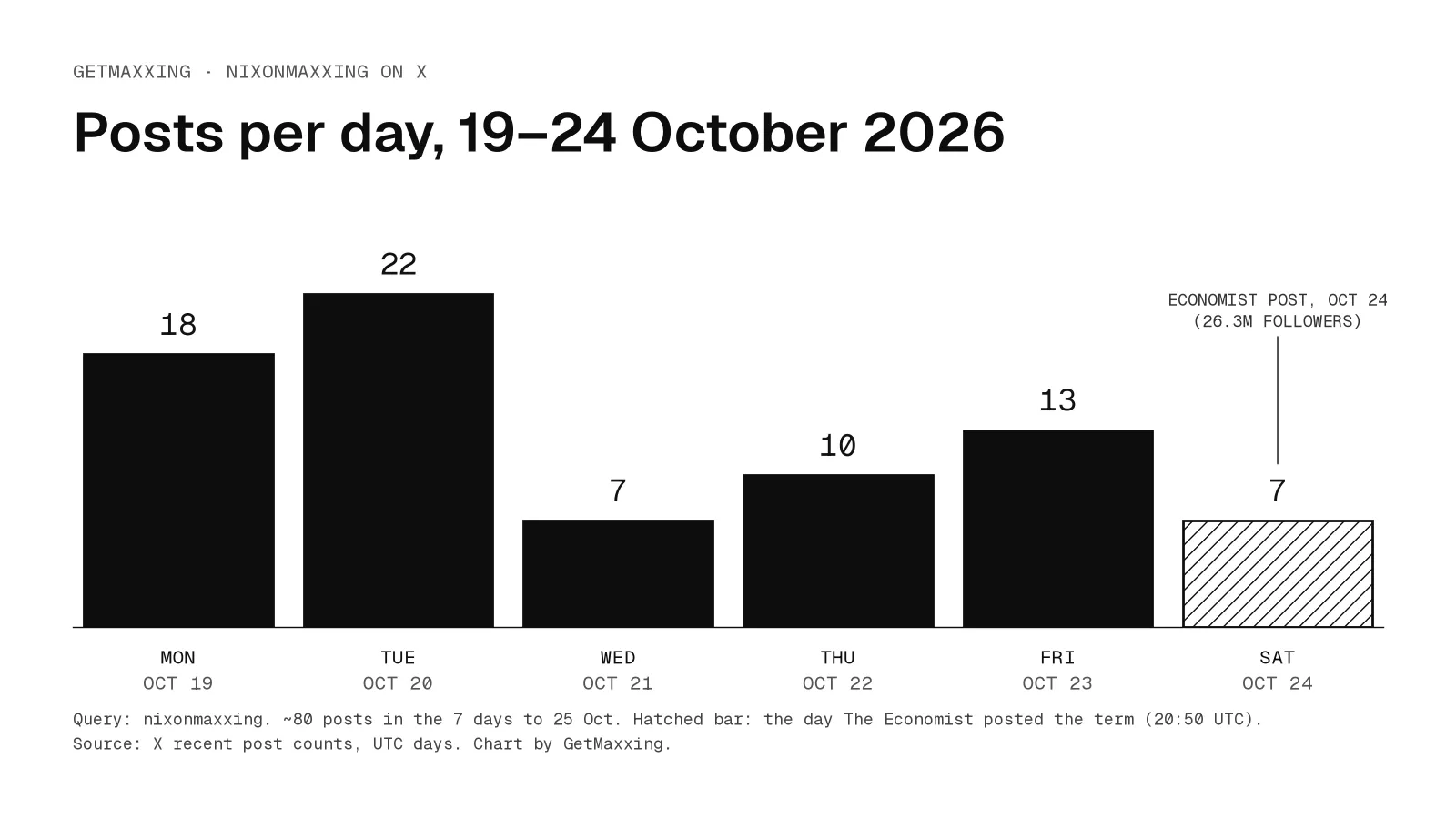
Every -maxxing term dreams of the same career arc: a forum in-joke, then a TikTok sound, then a trend piece in a paper your dad reads. Nixonmaxxing has skipped straight to the end. It now has write-ups in The Economist, the Financial Times, the Wall Street Journal and Vanity Fair. On X, it gets about 11 posts a day.
That is not a dunk. That is the most interesting thing about it.
The Economist makes it official
On October 24 at 20:50 UTC, The Economist’s X account, all 26.3 million followers of it, posted:
To looksmaxxing and gymmaxxing now add Nixonmaxxing. What explains the strange revival of the disgraced late president?
— The Economist (@TheEconomist) October 24, 2026
The post links to its October 22 piece, “Why Gen-Z conservatives love Richard Nixon.” By Sunday morning it had roughly 29,200 views, 14 likes, 7 replies and 3 reposts. That’s a brand-new coinage put in front of 26.3 million followers, and the followers mostly scrolled past.
The FT got there first. Joe Miller’s October 11 piece, “Nixonmaxxing: the strange revival of America’s disgraced president,” opens in a Ritz-Carlton ballroom in Washington at an event honouring “the greatest political comeback,” and credits Gen Z influencers with the revival. The WSJ’s Philip Wegmann and Vera Bergengruen put it in five words: “The kids are ‘Nixonmaxxing.’”
(For the record, and the only politics in this piece: Nixon resigned in 1974 over Watergate. We’re here for the hats.)
The hype edit
The engine of all this is the edit. The WSJ describes archival footage of the “famously square 37th president” cut over rap from Drake and Biggie Smalls, going viral on Instagram and YouTube. Vanity Fair flags one cut to Drake’s “National Treasures” and another, from the Nixon Foundation itself, set to “Cannonball” by Lithe and captioned with a single word: “Nixonmaxxing.”
That’s the whole caption. No explainer, no hashtag salad. The Foundation saw the suffix, understood the assignment and committed.
According to the Daily Wire, the Foundation says its edits have pulled 250 million views since October 2023. The best review came from a commenter quoted by the WSJ: “Nixon hype edit was not something I knew I needed.”
Nobody knew they needed it. That’s how hype edits work.
The merch
Then came the hats. Vanity Fair reports the phrase got popular enough that the Foundation turned it into a limited line of caps. On February 14, 2026, the Foundation posted: “Nixonmaxxing hats sold out in a few hours.” The Daily Wire has the finer print: the first drop sold out in 90 minutes, the second did too, and the total was 200 hats.
Two hundred. That’s the size of a decent house party, and it generated national coverage.
The rest of the range, per the WSJ, runs to caps, crew necks and fanny packs reading “Pretty Girls for Nixon” and “Nixon Now More Than Ever.” The fanny pack deserves its own paragraph, but we’ll let it speak for itself.
For latecomers there’s good news: the Nixon-Maxxing Cap is back in stock on the Foundation’s store at $24.95.
The suffix ate a president
The fun part here isn’t Nixon, it’s the grammar. The -maxxing suffix started on looksmaxxing forums as a word for optimising a single stat to the limit. Then it spread to gymmaxxing and beyond. Now it attaches to a dead president, and a presidential foundation uses it as a product name. It’s the purest example yet of the suffix working as a fandom marker: you’re not optimising Nixon, you’re maxxing your devotion to him.
The Economist’s framing gets this right without trying: “To looksmaxxing and gymmaxxing now add Nixonmaxxing.” The word is filed next to the jawline and the bench press. The suffix has gone mainstream, and that’s a win.
The count
Here’s where it gets funny. We pulled X’s post counts for “nixonmaxxing” across the week:
- Oct 19: 18
- Oct 20: 22
- Oct 21: 7
- Oct 22: 10
- Oct 23: 13
- Oct 24: 7
About 80 posts in seven days. And look at October 24, the day The Economist pushed the term to 26.3 million followers: 7. The post didn’t move the needle at all.
None of this means the trend is fake. The edits are real, the views are real and the hats really did sell out twice. The action just lives on Instagram and YouTube, where the edits are, not on X, where the newspapers are. The trend is real; the X conversation is mostly journalists.
That makes Nixonmaxxing a rare specimen: a -maxxing term with four major-outlet bylines and roughly a dozen people a day typing it out. Somewhere a Foundation social media manager is looking at 250 million views and 200 sold-out hats, and wondering why everyone keeps asking about X.
The hat’s back in stock. The posting is optional.