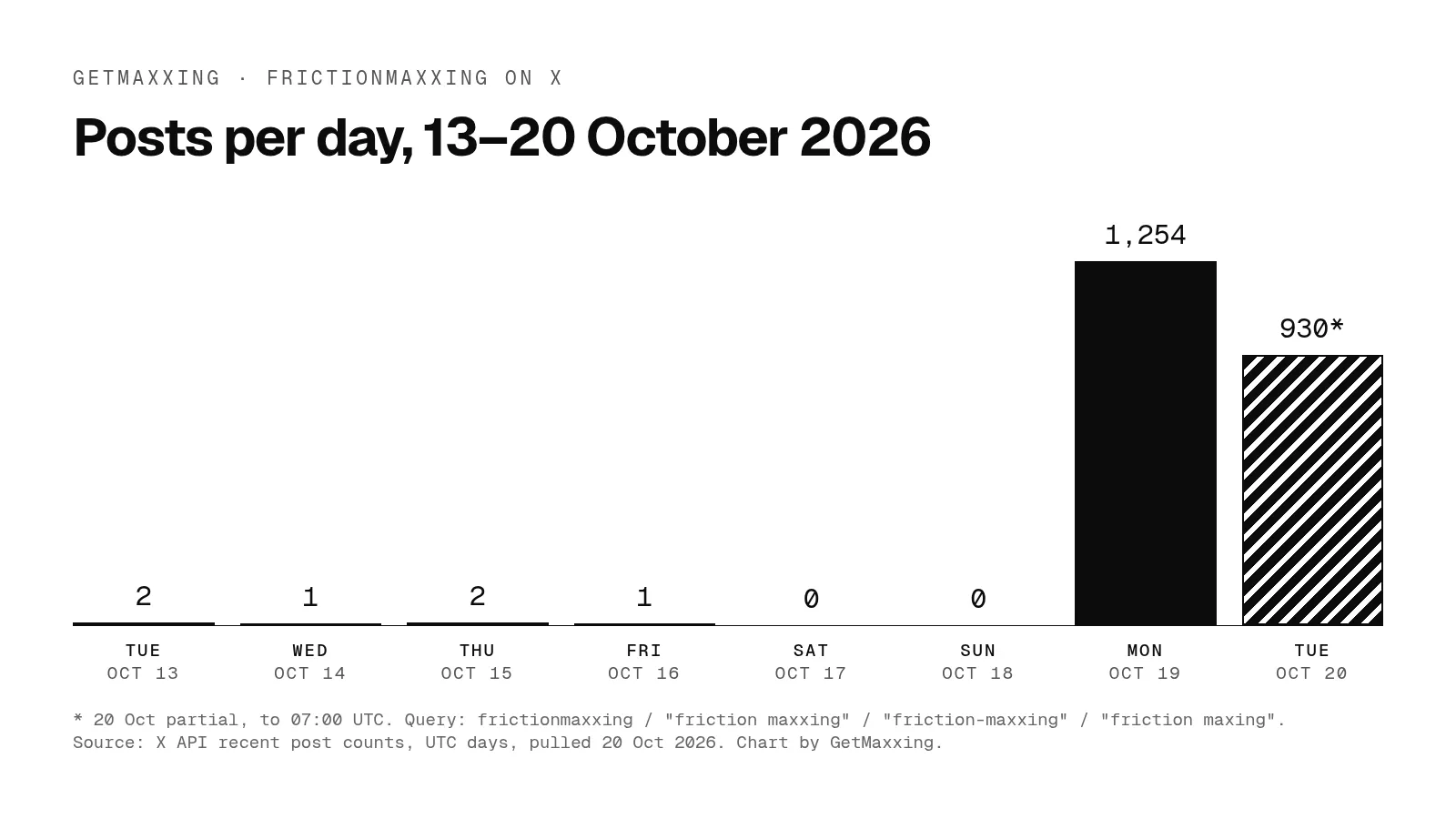
From 13 to 18 October, X recorded six posts using the word frictionmaxxing, in any of its spellings. Two on Tuesday, one Wednesday, two Thursday, one Friday, none all weekend.
On Monday it was 1,254. By 07:00 UTC this morning, another 930.
This is what did it:
I’m fascinated by the rise of frictionmaxxing as a response to a frictionless life. We engineer away inconvenience, only to discover that some of the friction we removed was part of what made life feel alive in the first place
— maja 🔭🍒 (@majamediaco) October 19, 2026
maja (@majamediaco, 18,300 followers, bio: “narrative operator, maker of memes”) posted at 19:29 UTC with two images: a cycle diagram titled “The Problem With a Frictionless Life” and a nine-square grid headed Friction Maxxing. 1.19 million views. 44,798 likes. 3,460 reposts.
And 16,785 bookmarks — more than one for every three likes. A list of slower ways to live, saved to read later.
The list
The grid is the product. Borrowing books from the library instead of downloading them. Taking the scenic route, “maybe even with a real map.” Calling a mentor instead of asking AI. A handwritten grocery list. Repairing clothes before replacing them (“weirdly satisfying”). Hosting friends at home instead of a bar. An album from beginning to end. An alarm clock, phone charging outside the bedroom. Growing herbs you could easily buy.
X’s own trending summary, “Frictionmaxxing: Bringing Back Life’s Small Inconveniences,” added vinyl and Kurt Vonnegut’s story about going out to buy a single envelope.
maja was quoting a post from that morning by Kristy Tillman (@KristyT, 39,200 followers): someone should write a book about technology “productizing the removal of friction in the name of convenience only for us to discover that the friction was a load-bearing part of the social compact.” 23,824 likes, 1.51 million views. Tillman supplied the thesis. maja supplied the word and the grid — and the word is what got searched.
This is the word’s second life
It isn’t new. Friction-maxxing was coined on 3 January 2026 by Kathryn Jezer-Morton in The Cut, “In 2026, We Are Friction-Maxxing,” as a New Year’s resolution: build up tolerance for “inconvenience,” which she argued is usually not inconvenience at all. The Guardian picked it up three days later. The Financial Times had workers “friction-maxxing” to resist AI by 31 January. It has its own Wikipedia page.
Then nine months of near silence on X — single digits a day this week — and a revival from a meme-maker’s grid. Press coined it; the timeline only now adopted it.
The reply section
The pushback came fast and it was mostly jokes:
- @TheZayanna (84,000 followers): “‘friction maxxing’ and it’s just a normal day in 1999.”
- @telefontelaviv: “All the stuff in the ‘friction maxxing’ page are like normal nice things to do if you’re a person.”
- @avikrishna: “Friction-maxxing is mostly nostalgia-maxxing.”
- @Danlacteal, in Spanish: the gringos call an ordinary Friday “friction maxxing.”
- @MYTHOTROPOS, raising the stakes: “Want some real frictionmaxxing? Try drafting your tweets in cursive, or only buy dried beans.”
And the practitioner’s answer, from @HOWDYBlTCH: “If calling it frictionmaxxing is what it takes to fix the general public’s dopamine levels then I’m all for it.” That one got 165 likes, three times the “normal day in 1999” crowd. @nichochar went further: “writing is a form of friction maxxing for thinking.”
The 1999 crowd is right about the content and wrong about the point. In 1999 the paper map wasn’t a choice. Choosing it is the whole move.
The suffix ate its own tail
The -maxxing suffix was built on forums for one job: find the stat, push it to the ceiling. Efficiency was the point. In August, Fortune’s me-maxxing showed the suffix could subtract — maximising the human contact you avoid. Frictionmaxxing is the mirror image: the stat being maximised is inefficiency itself. More steps, more waiting, more of the boring part.
That’s not dilution. That’s the suffix winning. A word made for optimising your jawline now names choosing the long way home, and it turned up in 2,190 posts this week without needing it explained. It’s also not quite the anti-maxxing backlash — those people wanted the suffix to stop. These people kept it and pointed it at the alarm clock.
The scene spent a decade removing every unnecessary step. The new flex is adding them back, on purpose, and posting the list.