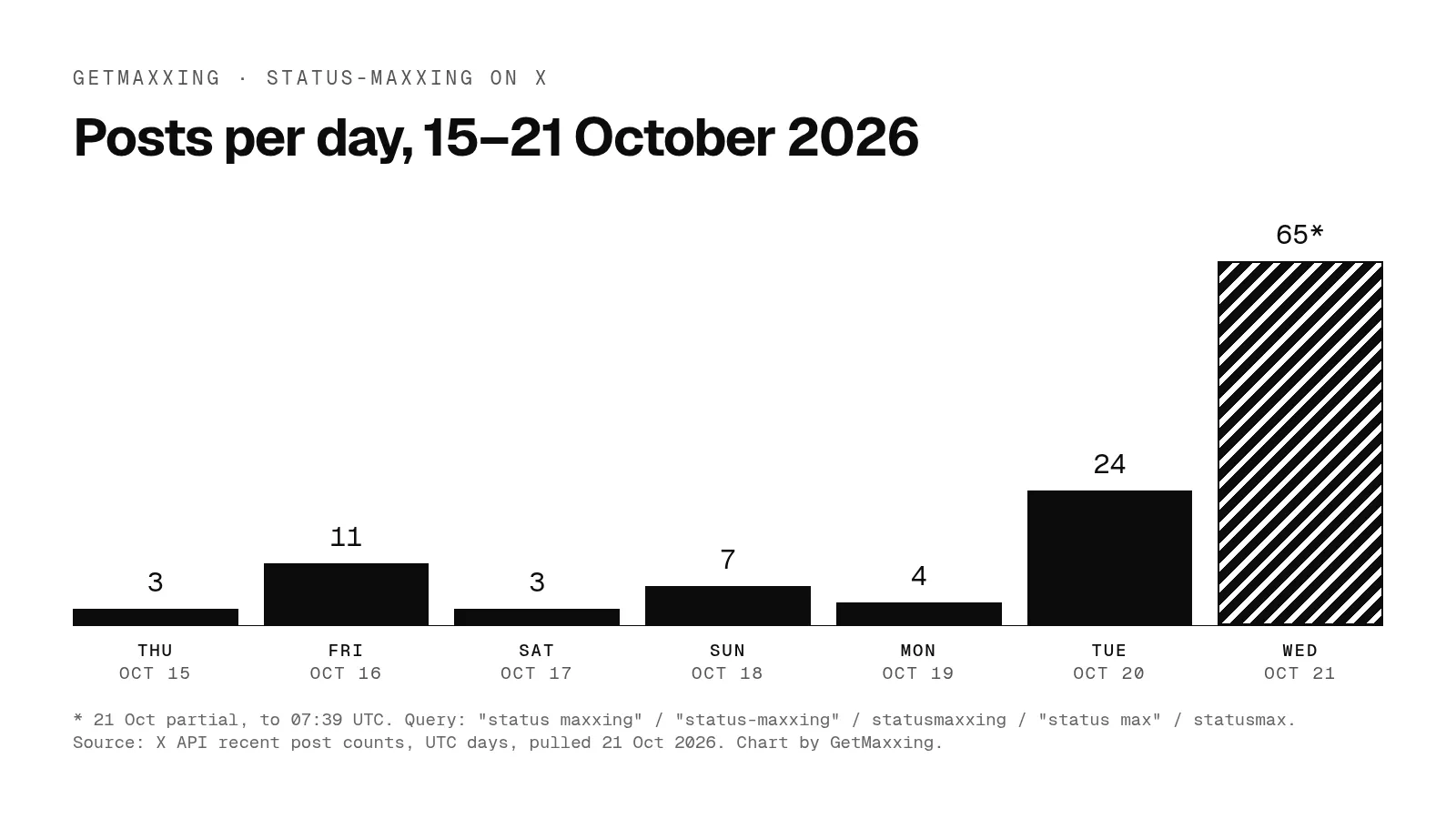
From 15 to 19 October, X recorded 28 posts using status-maxxing in any of its spellings — “status maxxing,” “status-maxxing,” statusmaxxing, “status max,” statusmax. Three on Thursday, eleven on Friday, three Saturday, seven Sunday, four Monday. An average of 5.6 a day. A term with a pulse, not a following.
On Tuesday it was 24. By 07:39 UTC this morning — 09:39 in Paris — it was 65.
That’s more than double the previous five days combined, in under eight hours. This is what did it:
people need to status max so much more
high status people saying ‘chasing status is bad’ is such an effective way of keeping everyone below them…
— gabriel (@gabriel1) October 20, 2026
gabriel (@gabriel1, 131,943 followers) posted at 19:07 UTC on Tuesday. By this morning: 235,043 views. 1,728 likes. 103 replies. 83 quote-posts. 55 reposts.
And 1,034 bookmarks.
Read the ratios
The bookmark count is the tell. That’s six bookmarks for every ten likes. Monday’s frictionmaxxing grid — a literal list of things to do — managed a little over one for every three. A list is made to be saved; a two-line opinion usually isn’t. This one got saved at about 1.6 times the rate.
Then the quote-posts: 83, against 55 reposts. More people took the post into their own feed to argue with it than passed it along clean. A reply is a comment; a quote-post is a position. The timeline didn’t share gabriel’s post so much as take sides on it.
The argument it set off is the second half of the sentence, not the first. “People need to status max” is a suggestion. “High status people saying ‘chasing status is bad’ is such an effective way of keeping everyone below them” is an accusation — that the advice to stop climbing comes mostly from people already at the top. Everyone who has ever been told ambition is unbecoming by someone with a better title felt seen. Everyone with the better title felt described.
The quote-post that proved the point
The loudest quote-post came at 22:56 UTC Tuesday, from Mandy Lu (@mandylu, 10,777 followers). She picked out one of gabriel’s lines — “literally the only reason why you care about a person you have not met is because they’ve done something publicly approved” — and answered it head-on:
made me physically disgusted reading this
not only is it not true, this kind of mindset is so inhumane. sad for him but also the fact that lots of tech bros think like this to some degree. reject treating people transactionally.
— Mandy Lu (@mandylu) October 20, 2026
113,660 views, 1,062 likes, 272 bookmarks, 78 replies, 11 quotes — a real counter-current, and a fair position stated plainly.
Then, at 00:50 UTC, @virtu101 (“gazingback”, 134 followers, San Francisco) replied with no argument at all. Just “he’s obnoxious but unfortunately kind of correct” and a screenshot of Mandy Lu’s own X bio: PhD at Stanford, AI at Google, ex-Nvidia, Apple. 151 likes, 3,177 views.
That’s the whole joke, and it isn’t on her. Her live bio reads “touching grass. applied math phd @Stanford, AI for climate/health @Google. ex-nvidia, apple. I like games.” (The screenshot says “comp math phd”; the live version says “applied math.”) It’s an ordinary bio for someone with that résumé. But it’s also exactly what gabriel was describing: the first thing a stranger learns about her is a stack of publicly approved credentials. The rebuttal to status-maxxing was posted from a profile that status-maxxes for her. Nobody on X escapes the ledger — the bio field is the ledger.
@sog_on_bird_app drew the scene’s usual line: “There’s a diff between genuinely status maxxing and larping status maxxing.” Nobody bothers telling genuine from larping in a trend that doesn’t exist.
Why this one travelled
The -maxxing suffix has always worked the same way: find the stat that actually moves outcomes, admit it out loud, push it to the ceiling. Looksmaxxing’s original sin, as far as polite society was concerned, was saying faces matter when everyone already knew they did.
Status is the same move at a different altitude. The stat has been real the whole time — who answers your messages, who gets the intro, who gets the room. What gabriel did was refuse the etiquette of pretending otherwise, and frame the etiquette itself as a status play. That’s why it got bookmarked like a manual: people weren’t saving a take, they were saving permission.
We keep a running statusmaxxing page for exactly this vocabulary — network, visibility, the whole ledger. Until Tuesday it was a niche of a niche. This morning’s say more than eight an hour.
What the numbers do and don’t say
Sixty-five posts is not a movement. It’s a partial day, cut at 07:39 UTC, on a term that was ticking along at single digits. Tuesday’s 24 includes hours before gabriel posted at all. Whether Wednesday finishes in triple digits, the counts will say by midnight UTC.
But the shape is unmistakable, and it’s the same shape every suffix revival has: a flat line, one post that says the thing plainly, and then everyone needing to have an opinion on it by breakfast.
The most effective way to keep everyone below you, it turns out, is to tell them not to climb. The most effective way to start a trend is to say so.